Objective: To explain the physiological necessity of Shockwave therapy in Canary Wharf athletes and how clinical integration speeds up recovery and prevents chronic tissue degradation.
Key Takeaways:
- Sports massage directly influences lymphatic drainage and micro-circulation to reduce recovery downtime.
- Regular soft tissue work identifies biomechanical imbalances before they lead to acute injury.
- Integration with clinical physiotherapy provides a comprehensive recovery strategy for high-performance training.
The title “Why Sports Massage in London Is a Must for Athletes” focuses on the intersection of physiological maintenance and the high-pressure training environment typical of city-based competitors. We see athletes daily who mistake simple soreness for unavoidable training fatigue, yet scientific data suggests otherwise. A meta-analysis found sports massage reduces DOMS intensity by 13% (SMD 1.13) post-exercise, aiding perceived recovery without direct performance boosts. This isn’t just about feeling relaxed after a session; it is about the measurable reduction of creatine kinase in the bloodstream and the management of inflammatory markers that would otherwise stall your progress.
Table of Content
- Why choose a sports injury clinic in Canary Wharf for your recovery?
- How does science support regular soft tissue work?
- Integrating massage into complex recovery plans
- Sustaining peak performance at our sports injury clinic canary wharf
- Frequently Asked Questions
Why choose a sports injury clinic at Canary Wharf for your recovery?
Athletes in the capital often operate on tight schedules where every training hour counts. Choosing a sports injury clinic in Canary Wharf allows you to move beyond basic spa treatments and into evidence-based rehabilitation. We focus on the specific demands of your sport, whether you are a marathon runner navigating hard pavement or a CrossFit enthusiast dealing with high-volume shoulder load. Our approach isn’t a one-size-fits-all rubdown. We look at the kinetic chain. If your glutes are inhibited, your hamstrings will overwork, leading to the tightness you feel. We address the cause, not just the symptom. Beyond manual therapy, we utilize advanced technology like Shockwave therapy in Canary Wharf to treat chronic conditions like plantar fasciitis or Achilles tendinopathy that often plague city runners. You can book your initial assessment with our team to start your recovery journey.
The physiological mechanics of tissue manipulation
When we apply pressure to muscle tissue, we aren’t just moving skin. We are affecting the fascia, the connective tissue that wraps around every muscle fibre. Over time, training causes micro-tears and adhesions. These “knots” restrict your range of motion. By manually breaking down these adhesions, we restore the sliding surface between muscle layers. For deeper muscular knots, Dry needling in Canary Wharf is an effective adjunct, resetting the neuromuscular system and providing immediate relief from chronic tension.
- Circulatory Boost: Increased blood flow brings oxygenated blood to damaged cells.
- Waste Removal: Improved lymphatic flow carries away metabolic byproducts.
- Pain Modulation: Deep pressure inhibits pain signals sent to the brain, allowing for better relaxation.
When self-maintenance isn’t enough, specialized Knee injury physio in Canary Wharf sessions can address structural issues that a standard massage might only temporarily mask.
Improving lymphatic drainage and blood flow
The lymphatic system doesn’t have a pump like the heart. It relies on movement and external pressure. London athletes who sit at desks for ten hours before hitting the gym often have sluggish circulation. Sports massage acts as a manual pump. This is vital for clearing the “sludge” that accumulates after a heavy leg day or an endurance cycle. While massage moves fluid physically, Sports acupuncture Canary Wharf helps regulate the nervous system’s response to inflammation, making it a staple for athletes in high-stress training phases.
Why hydration matters post-treatment
We always remind our clients to drink water immediately after a session. Massage releases stored metabolic waste into the circulatory system. Without proper hydration, you might feel a “massage hangover” – a slight lethargy or headache. Water helps your kidneys process and flush these substances out of your system.
How does science support regular soft tissue work?
The science of recovery has shifted away from complete rest toward active management. Soft tissue work is a form of active recovery that doesn’t add more stress to the central nervous system. When you train, your muscles tighten as a protective mechanism. If that tension isn’t released, it becomes your new “baseline.” This restricted state is where injuries happen.
We often see clients coming in for a knee injury physio Canary Wharf appointment only to find that their knee pain started as a quad and IT band tightness that a regular massage could have mitigated. Science shows that maintaining tissue elasticity reduces the sheer force on joints during explosive movements. View our full range of services to see how we manage joint health.
Mitigating Delayed Onset Muscle Soreness (DOMS)
DOMS can ruin a training block. If you can’t hit your target splits because your legs are too stiff, your performance plateaus. Massage doesn’t just make you feel better; it reduces the swelling within the muscle cells. By managing this inflammation early, we can get you back to your next high-intensity session twenty-four to forty-eight hours sooner than rest alone would allow.
Integrating massage into complex recovery plans
We believe that massage is most effective when it is part of a broader clinical strategy. If you are recovering from surgery, such as an ACL rehabilitation Canary Wharf programme, massage is used to manage the scar tissue and compensatory patterns that develop during crutch use or limited gait. It is one tool in a larger toolkit designed to return you to sport at 100% capacity.
Synergy with modern clinical modalities
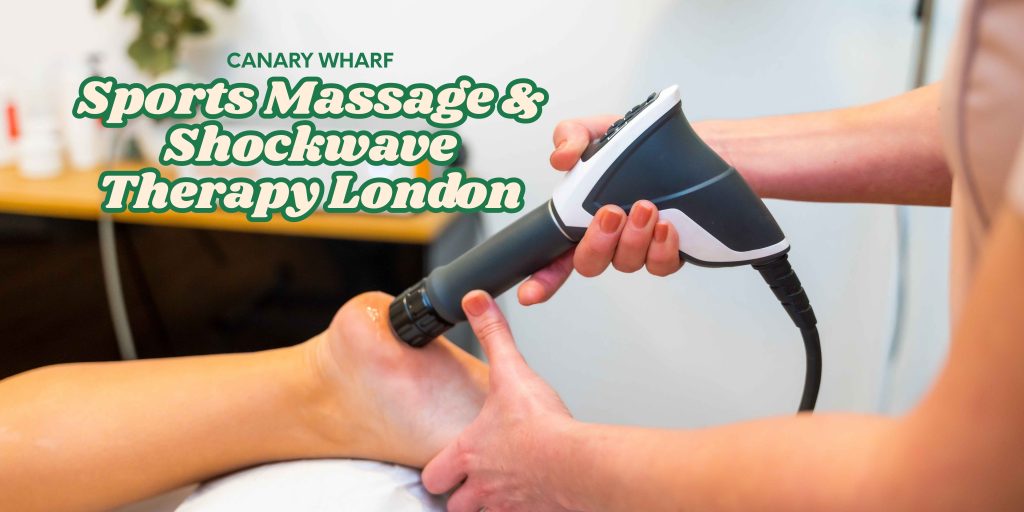
Sometimes, manual hands-on work needs an extra boost. For chronic tendon issues or stubborn calcifications, we might combine your soft tissue work with Shockwave therapy. This acoustic energy triggers a healing response in tissues that have become stagnant.
- Dry needling: We use this to hit deep trigger points that fingers can’t reach.
- Sports acupuncture: This helps in modulating the nervous system and reducing systemic inflammation.
These treatments work together. A massage might loosen the superficial fascia, while needling hits the deep-seated tension, creating a comprehensive release.
Sustaining peak performance at our sports injury clinic in canary wharf
Long-term success in sport requires a proactive mindset. Waiting until you are limping to book a session is a reactive strategy that costs you time and progress. At our sports injury clinic in canary wharf, we help you build a maintenance schedule that fits your competitive season. Whether you need a pre-event flush to wake up the muscles or a deep post-event session to clear out the damage, consistency is what prevents the catastrophic failures that end seasons. Our team provides high-level ACL rehabilitation Canary Wharf for those returning from major surgery, ensuring the transition back to competitive sport is both seamless and safe. Contact us today to find a therapist who understands your specific athletic goals.
Frequently Asked Questions
How often should an athlete get a sports massage?
For most competitive athletes, once every two weeks is the sweet spot for maintenance. However, during high-volume training blocks or leading up to a marathon, weekly sessions may be necessary to manage the increased load. If you are in an off-season or maintenance phase, once a month is usually enough to keep the fascia healthy.
Is a sports massage supposed to be painful?
It shouldn’t be unbearable. While “deep tissue” work involves some discomfort as we address adhesions, we work within your pain tolerance. Communication is key. If you are tensing up against the pressure, the muscle won’t release, and the session becomes counterproductive. It should be a “productive” type of discomfort.
Can I train immediately after a sports massage?
We recommend taking the rest of the day off or doing very light activity. Deep work can leave your muscles feeling slightly tender or “unstable” for a few hours. Your body needs time to process the circulatory changes and the waste release. A light walk or swim is fine, but avoid your heaviest lifting session.
Where is your sports injury clinic canary wharf located?
Our sports injury clinic canary wharf is conveniently situated to serve the local athletic community and professionals in the Docklands area. We offer flexible hours, including early mornings and late evenings, to accommodate the schedules of London’s busiest competitors.
What is the difference between sports massage and deep tissue massage?
A deep tissue massage is often a general full-body treatment focusing on deep layers. A sports massage is highly targeted and functional. We might spend the entire hour on your hips and lower back if you are a cyclist. We use specific techniques like PNF stretching and trigger point release that are tailored specifically to athletic movement patterns.